
Library Details
Product Descriptions
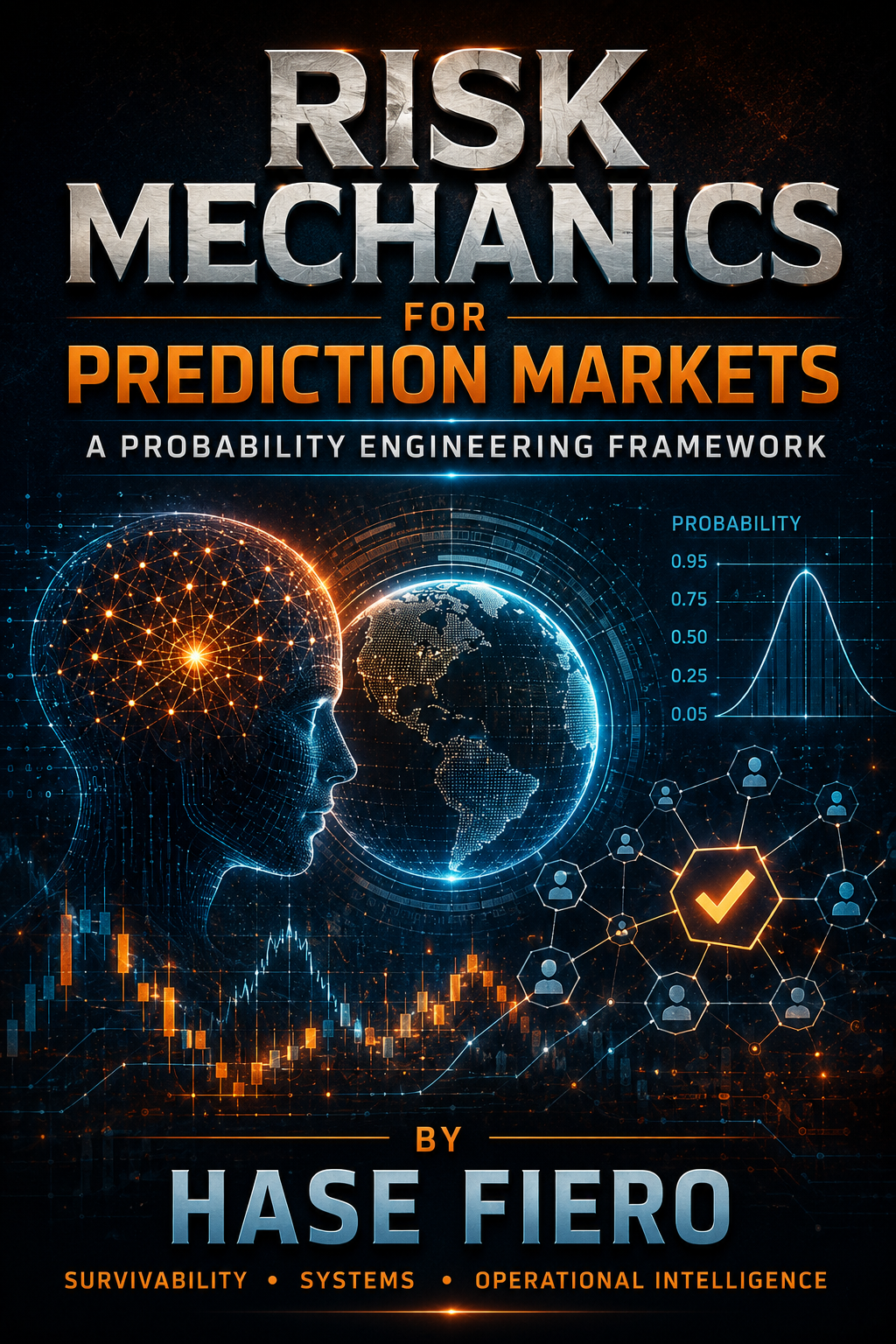
Risk Mechanics for Prediction Markets
A Probability Engineering Framework
Prediction markets are exploding into public awareness.
Politics. Economics. Sports. culture. global events. breaking news. Every contract looks simple on the surface:
Yes or No.
But beneath that simple interface is one of the most unforgiving financial environments a participant can enter.
A prediction market is not just a question about the future.
It is a contract that prices belief, locks capital, moves with information, and resolves to either zero or one hundred.
There is no middle ground.
There is no partial credit.
There is no recovery after final resolution.
That is why most participants misunderstand the game before they ever place their first trade.
They think prediction markets are about being right.
This book teaches a different truth:
Prediction markets are about surviving belief.
This Is Not a Book of Picks
This is not a book promising hot trades, secret markets, political predictions, or guaranteed outcomes.
It does not teach you to gamble on headlines.
It teaches you how to think like a probability engineer.
Because prediction market accounts rarely fail from one bad read alone.
They fail because:
conviction replaces calibration
liquidity disappears when exit matters most
resolution risk is ignored
participants trust the last price instead of the order book
losses cluster across related contracts
attention fragments across too many markets
and the operator keeps participating after edge has decayed
The danger is not simply being wrong.
The danger is being structurally unprepared to be wrong at scale.
The Core Reframe
Most beginners ask:
“Will this happen?”
A probability engineer asks:
“At this price, with this liquidity, this resolution clock, this source risk, and this position size, is this participation survivable?”
That question changes everything.
Inside this book, you will learn the foundational model behind disciplined prediction market participation:
Price = Implied Probability
A contract trading at 30 cents is not “cheap.”
It is the market saying the event has roughly a 30% chance of resolving yes.
A 90-cent contract is not automatically safe.
It may have only 10 cents of upside and 90 cents of downside if the unlikely outcome occurs.
The edge is not the outcome.
The edge is the gap between the market’s implied probability and your independently researched probability.
The Three Forces That Govern Every Contract
This book introduces the Three-Force Model:
Probability. Resolution. Liquidity.
Probability gives you the edge.
Resolution gives you the clock.
Liquidity gives you the door.
If any one of those forces is misunderstood, the trade can become dangerous.
A participant can be correct about the final outcome and still lose because they sized too aggressively, could not survive temporary drawdown, entered a thin book, trusted a misleading mark-to-market value, or misunderstood the contract’s resolution terms.
This book teaches you to stop treating prediction markets like simple bets and start treating them like engineered positions.
Execution Reality: What the Screen Does Not Tell You
Prediction market screens can be deceptive.
The last printed price may not be the price you can actually trade.
The mark-to-market value may not be the amount you could actually exit with.
The order book may be too thin to absorb your size.
The spread may consume the edge before the trade even begins.
This book teaches why:
the last print often lies
partial fills can signal adverse selection
wide spreads can destroy expected value
resolution-day liquidity can vanish
and unrealized P&L is not real until settlement is final
In prediction markets, the screen is a representation.
The fill is the fact.
Failure Mechanics: Why Smart People Blow Up
Prediction markets punish unstructured intelligence.
A smart participant can still collapse through a belief cascade.
One wrong estimate becomes a stronger conviction.
The position moves against them.
Instead of updating, they double down.
Then they add related markets.
Then they build a narrative defending the original mistake.
By the time resolution arrives, one wrong read has become a portfolio-level failure.
This book names and explains the patterns most participants only discover through losses:
conviction chains
calibration decay
narrative traps
thin-book stacking
resolution-date clustering
attention fragmentation
the long-tail spiral
These are not moral failures.
They are mechanical failure modes.
And mechanical failures require engineered defenses.
The Probability Engine
The center of this book is the shift from forecaster to engineer.
A forecaster tries to be right.
An engineer builds a system that survives being wrong.
You will learn the four components of a probability engine:
1. Position Sizing Rules
So conviction does not become overexposure.
2. Calibration Filters
So weak edges are rejected before capital is committed.
3. Resolution Risk Caps
So ambiguous, disputed, or high-risk settlements cannot dominate the portfolio.
4. Termination Logic
So exits are determined before emotional pressure corrupts judgment.
This is the framework that turns opinions into structured participation.
Kalshi, Polymarket, and Platform-Specific Engineering
The book also examines Kalshi and Polymarket as different operating environments.
Not as interchangeable apps.
As different architectures.
Kalshi’s centralized adjudication, fee structure, funding rails, KYC model, and regulated exchange mechanics produce one set of engineering implications.
Polymarket’s oracle-based resolution, wallet structure, US and international differences, blockchain settlement, and dispute mechanics produce another.
The same event can behave differently across platforms.
The same price can carry different friction.
The same resolution can involve different risks.
This book teaches how to think across both.
Who This Book Is For
This book is for readers who want more than surface-level prediction market content.
It is for:
beginners who want to avoid expensive mistakes
traders moving from equities, futures, or options into event contracts
researchers who want to convert analysis into structured participation
builders designing AI-assisted prediction intelligence
operators who want a disciplined framework before risking capital
and anyone who understands that being right is not enough
The Final Lesson
Prediction markets do not reward opinion.
They reward calibrated belief, disciplined sizing, realistic execution, resolution awareness, and operational stability.
The market is not asking you to be certain.
It is asking whether you can take a position at a price and survive the time between decision and adjudication.
That is the central lesson of this book.
Prediction markets are not gambling.
They are not simply betting.
They are not just forecasting.
They are probability engineering.
And survival is not opinion.
Survival is engineered.