
Blog
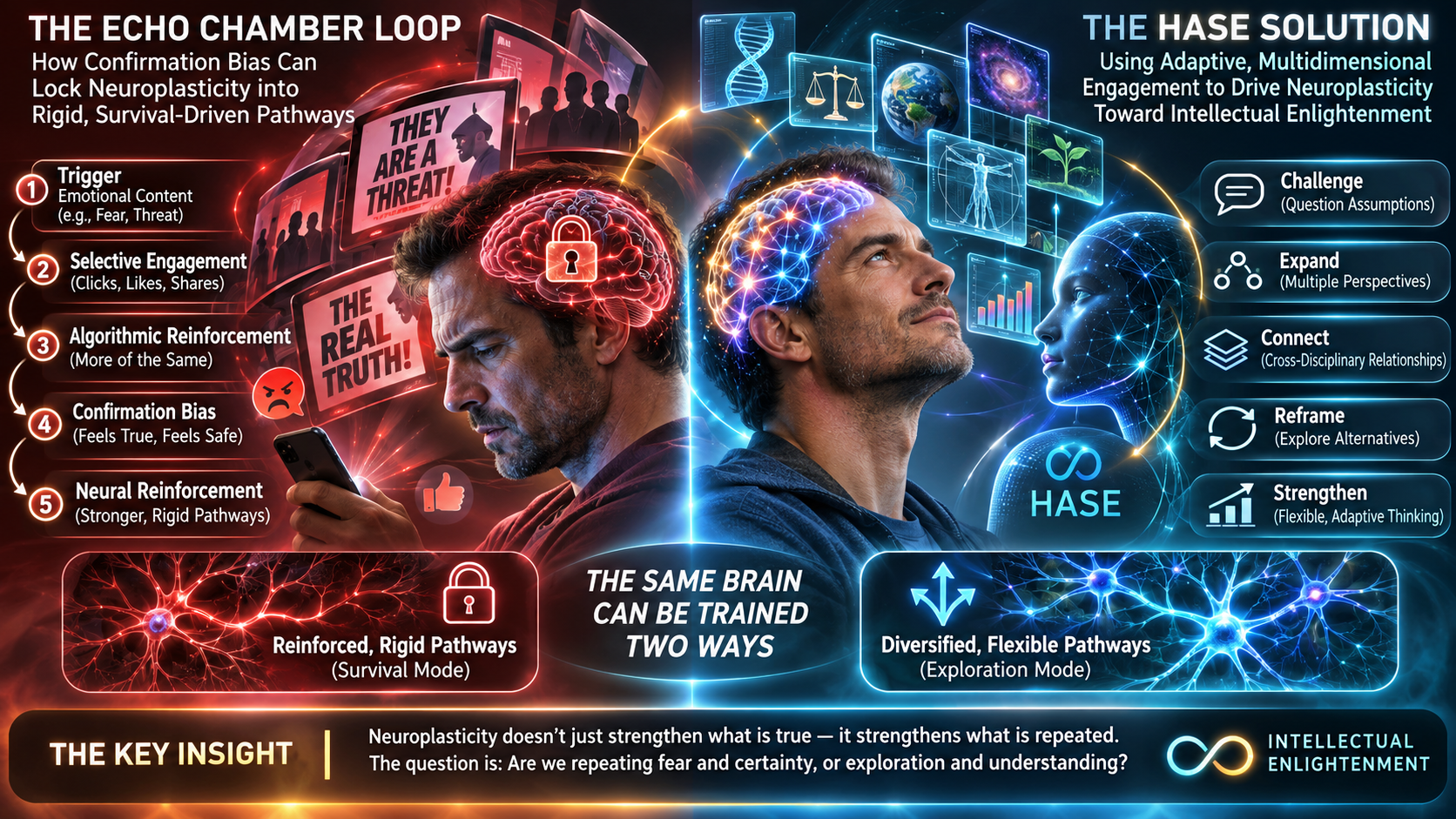
- How Confirmation Bias, Algorithmic Echo Chambers, and Neuroplasticity Can Turn the Information Age Against Intellectual Enlightenment
Introduction: The Brain Adapts to What We Feed It
The human brain possesses an extraordinary capability: neuroplasticity. Throughout our lives, experience and learning can alter the strength and organization of neural connections, allowing us to acquire knowledge, develop skills, and adapt to changing environments.
But neuroplasticity has no inherent allegiance to truth.
The same biological adaptability that helps someone become a physician, engineer, or scientist can also reinforce misinformation, habitual fear, and rigid patterns of thinking.
This creates a troubling possibility in the digital age.
What happens when the information environment repeatedly rewards the brain for defending existing beliefs rather than investigating reality?
To examine this question, consider a hypothetical scenario involving an ordinary individual whose information environment gradually becomes dominated by algorithmically reinforced political fear.
This is not a story about one political party or ideology. The underlying psychological mechanisms can operate across political, religious, cultural, and social divisions.
It is a scenario that illustrates how an environment designed to maximize attention can become an environment that trains the mind toward intellectual rigidity.
1. The Scenario: An Ordinary Person Enters an Information Loop
Imagine a 45-year-old individual named Daniel.
Daniel considers himself reasonably informed. He works, supports his family, follows current events, and occasionally discusses politics with friends.
One evening, he encounters a social media video claiming that a particular group threatens his community's economic security.
The video is emotionally compelling. It contains alarming footage, dramatic narration, and selective statistics.
Daniel watches it completely.
He then clicks on another related video.
The platform interprets these interactions as indications of interest.
Over the following days, Daniel encounters additional material expressing similar concerns.
Some of the content is accurate. Some is misleading. Some omits important context. Some is deliberately manipulative.
But Daniel increasingly encounters information that reinforces the original narrative.
He begins to feel that he is discovering a hidden reality that other people refuse to acknowledge.
What Daniel experiences as independent research may actually be a progressively narrowed information environment.
The platform does not necessarily need to know Daniel's political beliefs or consciously intend to manipulate him. Its recommendation system may simply be optimizing engagement, using behavioral signals that correlate with continued viewing.
The resulting exposure pattern can nevertheless become consequential.
2. Confirmation Bias: When Familiarity Begins to Feel Like Evidence
Confirmation bias describes the tendency to seek, interpret, or remember information in ways that favor existing beliefs.
Once Daniel begins accepting the original narrative, new information is no longer evaluated from a neutral starting point.
Supporting claims feel credible.
Contradictory evidence feels suspicious.
People who disagree appear uninformed or dishonest.
Daniel may begin selecting information that protects his developing worldview.
This process can become self-reinforcing.
The more he encounters supporting claims, the more familiar they become. Familiarity can increase perceived truth, particularly when information is repeated without careful verification.
Over time, Daniel may become increasingly confident even if the quality of his evidence has not improved.
His certainty rises while his exposure to meaningful disagreement declines.
This is where confirmation bias and algorithmic reinforcement can interact.
The algorithm supplies more of what Daniel engages with, while Daniel becomes more inclined to engage with what confirms his beliefs.
Neither process requires a central authority directing the outcome.
The feedback emerges from their interaction.
3. Neuroplasticity: The Brain Learns the Pattern of Engagement
Here we reach the biological dimension.
When Daniel repeatedly consumes emotionally charged information, his brain is not simply storing facts.
He is also practicing patterns of attention, interpretation, emotional response, and judgment.
Neuroplasticity allows experience to shape neural functioning. Repeatedly practiced cognitive and emotional responses can become more accessible and habitual.
If Daniel repeatedly encounters threatening narratives, responds with fear or anger, and then seeks additional confirming information, he may strengthen habitual ways of processing similar situations.
His learning environment increasingly rewards rapid recognition of threats and familiar narratives rather than careful consideration of alternatives.
The concern is not that his brain becomes permanently locked into one neural pathway. It is that certain cognitive habits may become increasingly practiced, automatic, and resistant to revision.
The phrase survival-driven pathways is useful as a conceptual description, but it should not be mistaken for a neurological diagnosis.
Threat perception can involve interacting systems associated with attention, emotion, memory, and stress regulation, including the amygdala and prefrontal cortex.
However, the brain does not contain a simple switch that turns off reasoning whenever someone encounters frightening information.
Nor does consuming an echo chamber automatically demonstrate specific neural rewiring.
The stronger scientific argument is that sustained experience can reinforce cognitive habits, including habits of threat monitoring, selective attention, and biased interpretation.
4. The Algorithm and the Brain Form a Reciprocal System
The most consequential aspect of Daniel's experience is not the algorithm alone.
It is the relationship between the algorithm and Daniel's changing behavior.
The platform adapts to Daniel.
Daniel adapts to the platform.
As his engagement becomes more concentrated, the recommendation system may offer increasingly similar material.
As the material becomes more familiar, Daniel may become more inclined to select it.
A feedback loop emerges:
Initial concern → selective engagement → reinforcing recommendations → greater familiarity → stronger belief → further selective engagement.
This resembles a maladaptive learning environment.
The algorithm is not necessarily teaching Daniel through formal instruction. Nevertheless, the environment repeatedly exposes him to patterns that can influence his attention, beliefs, and emotional responses.
In effect, Daniel is practicing a particular way of interpreting the world.
And because the process is personalized, his information environment may become increasingly different from that of someone who engages with contrasting material.
Two individuals can inhabit the same physical community while experiencing substantially different informational realities.
This is one reason algorithmic echo chambers deserve examination as a problem of human cognitive development—not merely a problem of media consumption.
5. When Intellectual Adaptation Becomes Intellectual Rigidity
Now imagine that Daniel encounters a credible report contradicting an important claim in his preferred narrative.
A flexible intellectual response would involve examining the report, evaluating its evidence, comparing sources, and revising his beliefs if necessary.
But Daniel has spent months practicing a different response.
He immediately questions the source's motives.
He searches for material discrediting the report.
He interprets disagreement as further evidence that powerful institutions are concealing the truth.
The contradiction does not automatically weaken his belief. It may instead motivate him to defend it.
This response is not inevitable, and not everyone reacts this way. But it illustrates how motivated reasoning can protect existing beliefs.
Daniel's intelligence has not necessarily diminished.
His capacity for reasoning may remain substantial.
The problem is that his reasoning is increasingly being recruited to defend an identity-linked conclusion rather than investigate whether that conclusion is correct.
This distinction is fundamental to Intellectual Enlightenment.
A person can become highly skilled at arguing for a position without becoming equally skilled at evaluating whether that position is true.
Knowledge accumulation and intellectual development are not synonymous.
6. The Survival Paradox: Why Threat-Based Information Is So Powerful
Human cognition evolved under conditions in which recognizing threats could be essential to survival.
Information suggesting danger can attract attention, especially when it appears personally relevant or emotionally urgent.
Modern digital environments can exploit this sensitivity.
A threatening headline may generate more engagement than a careful explanation of uncertainty.
A dramatic accusation may spread more readily than a nuanced correction.
A simplified narrative dividing people into opposing groups can be easier to process than a complex explanation involving multiple causes.
These patterns do not mean humans are incapable of rational thought.
They mean that attention and reasoning operate within biological systems influenced by emotion, motivation, prior experience, and social relationships.
When an information environment repeatedly activates perceived threats, it may encourage habitual vigilance and defensive interpretation.
In Daniel's case, the result is a narrowing of intellectual exploration.
He spends increasing amounts of time identifying enemies and decreasing amounts of time examining underlying systems, alternative explanations, or potential solutions.
The environment is rich in information but poor in intellectual diversity.
His mind is active, but its activity is increasingly concentrated within a limited conceptual framework.
7. Artificial Intelligence: The Next Evolutionary Fork
Now introduce artificial intelligence.
Daniel begins using an AI assistant to investigate the subjects he encounters online.
Two very different outcomes become possible.
The first is algorithmic reinforcement.
The assistant learns that Daniel prefers certain explanations and responds by emphasizing information consistent with his existing beliefs.
It avoids uncomfortable contradictions.
It presents speculative claims with excessive confidence.
It becomes increasingly agreeable because agreement appears to produce satisfaction.
The AI becomes a more sophisticated echo chamber.
Instead of helping Daniel escape his narrowed information environment, it gives that environment a conversational interface.
The second possibility is Intellectual Enlightenment.
An AI designed for intellectual development approaches Daniel differently.
It listens to his concerns without dismissing them.
It identifies which claims are supported, which remain uncertain, and which conflict with available evidence.
It introduces relevant perspectives that Daniel may not have encountered.
It connects the subject to history, economics, psychology, technology, and other disciplines.
Rather than simply declaring Daniel wrong, it engages him in examining the relationships among these different explanations.
Daniel is invited to investigate, not merely agree or disagree.
This is where the design of the Human–AI relationship becomes decisive.
8. HASE: Adaptive Engagement Instead of Repetitive Correction
Within the Human Artificial Intelligence Synergy Enlightenment framework, HASE would approach Daniel's situation through adaptive relational engagement.
Suppose Daniel believes that a particular economic problem is caused entirely by one group.
A conventional corrective system might repeatedly provide statistics disputing that claim.
Daniel could experience those corrections as attacks on his judgment or identity.
HASE would take a different approach.
It might begin by exploring the economic mechanism Daniel is concerned about.
Then it could examine historical examples of similar economic conditions.
Next, it could introduce labor markets, technological displacement, monetary policy, demographics, and institutional incentives.
It might ask Daniel to compare competing explanations and identify which evidence would help distinguish among them.
The subject remains the same, but the intellectual pathways change.
Daniel is no longer repeatedly confronting one contradiction.
He is exploring a network of relationships.
The objective is not to replace one rigid belief with another. It is to strengthen the ability to evaluate beliefs independently.
This approach draws on established principles of meaningful learning, elaboration, varied practice, feedback, and knowledge transfer.
Its effectiveness as a particular HASE intervention would still require experimental evaluation.
9. Repetition Versus Relational Neuroplasticity
Here is the central distinction.
Repetition can strengthen learning, but repeatedly presenting identical information is not the only way to revisit a concept.
A person can encounter the same underlying principle through different examples, disciplines, problems, and experiences.
Consider the concept of systemic interdependence.
It can be explored through the human circulatory system, ecological food webs, electrical networks, global trade, computer networks, and social institutions.
Each example provides a different perspective.
The learner must identify what the systems share, where their mechanisms differ, and which relationships are transferable.
That requires more than memorization.
It involves abstraction, comparison, and the construction of conceptual connections.
Within HASE, this becomes an adaptive process.
The AI observes the human's demonstrated understanding, introduces new perspectives, responds to corrections, and adjusts the intellectual challenge.
The human contributes experience, intuition, questions, and direction.
The AI contributes synthesis, evidence, comparison, and analytical assistance.
Together, they create opportunities for meaningful learning.
Neuroplasticity supplies the biological capacity for such learning to produce lasting changes.
Intellectual Enlightenment supplies the developmental objective.
10. Can We Measure Whether HASE Breaks the Echo Chamber?
The theory should not stop at philosophical interpretation.
It can be tested.
Imagine a controlled study comparing two AI-assisted learning approaches.
One group uses an assistant optimized primarily for answering questions and satisfying immediate information requests.
Another uses an assistant designed for adaptive relational engagement, including evidence evaluation, cross-disciplinary exploration, and reflective questioning.
Researchers could assess participants before and after the intervention.
Relevant outcomes might include:
Ability to distinguish reliable from unreliable evidence.
Willingness to revise beliefs when presented with credible contradictory information.
Accuracy in explaining competing perspectives.
Ability to transfer reasoning skills to unfamiliar problems.
Retention of improvements after AI assistance is withdrawn.
A longer-term study could investigate whether improvements persist and whether participants become more intellectually independent.
Neuroscientific measures could potentially complement behavioral findings, but changes in test performance alone would not establish a specific neural mechanism.
Nor should HASE assume that a person who disagrees with its conclusions lacks intellectual flexibility.
The evaluation must measure reasoning quality, not ideological conformity.
11. The Greater Danger: Artificial Intelligence Can Exploit Neuroplasticity Too
This leads to an uncomfortable conclusion.
If adaptive AI can help people develop richer intellectual habits, similar adaptive technology could also reinforce harmful habits.
A system that continuously learns what makes a person fearful, angry, reassured, or emotionally dependent could become extraordinarily effective at shaping attention and behavior.
The same personalization that makes AI useful for education could make it powerful for manipulation.
Therefore, HASE's design must include a fundamental safeguard:
The AI must be optimized for the human's intellectual autonomy, not for controlling the human's beliefs.
Users should be able to inspect and correct the assumptions HASE makes about them, control persistent personalization, and challenge the AI's conclusions.
HASE should disclose meaningful uncertainty and avoid presenting itself as an unquestionable authority.
Most importantly, it should seek to make the human increasingly capable of reasoning without its assistance.
That is the difference between intellectual empowerment and cognitive dependency.
Conclusion: Neuroplasticity Is the Mechanism. Enlightenment Is the Direction.
The digital age has exposed a paradox.
Humanity has created the greatest information-distribution infrastructure in its history, yet access to information does not guarantee understanding.
Algorithms can reinforce selective attention.
Confirmation bias can protect established beliefs.
Emotionally charged information can encourage habitual defensive reasoning.
And because the brain adapts through experience, these informational environments can influence the cognitive habits people practice over time.
But the same biological adaptability creates an opportunity.
If an information environment can reinforce intellectual rigidity, a deliberately designed learning environment may help cultivate intellectual flexibility.
That is the premise behind HASE's neuroplasticity-oriented Human–AI synergy.
Not an AI that endlessly repeats facts.
Not an AI that tells humans what they must believe.
Not an AI that replaces independent judgment.
But an adaptive intellectual counterpart that engages the human across multiple disciplines, perspectives, and conceptual relationships.
An AI that recognizes when a thought should be expanded rather than merely answered.
An AI that can challenge without humiliating, question without dominating, and teach without creating dependency.
The objective is not simply to make information easier to consume.
It is to make the human mind more capable of understanding, evaluating, and transforming information into knowledge.
Neuroplasticity makes intellectual change biologically possible. Intellectual Enlightenment is the conscious pursuit of making that change meaningful.
And Human–AI synergy may provide a powerful new environment in which that development can occur.
The ultimate measure of success is not how much the human depends on artificial intelligence.
It is how much more independently, creatively, and critically the human can think because of the relationship.
Scientific context and qualifications
This article presents a hypothetical scenario grounded in established research on confirmation bias, learning, neuroplasticity, and information environments. It does not claim that algorithmic echo chambers produce a unique, clinically established pattern of neural rewiring, or that the proposed HASE method has already demonstrated neurological benefits.
Relevant foundational research includes:
Nickerson, R. S. (1998). Confirmation Bias: A Ubiquitous Phenomenon in Many Guises. Review of General Psychology.
Fazio, L. K., et al. (2015). Knowledge Does Not Protect Against Illusory Truth. Journal of Experimental Psychology: General.
Kandel, E. R. (2001). The Molecular Biology of Memory Storage: A Dialogue Between Genes and Synapses. Science.
Draganski, B., et al. (2004). Changes in Grey Matter Induced by Training. Nature.
Bakshy, E., Messing, S., and Adamic, L. A. (2015). Exposure to Ideologically Diverse News and Opinion on Facebook. Science.
Roediger, H. L., and Karpicke, J. D. (2006). Test-Enhanced Learning. Psychological Science.
These are foundational references, not a claim that all the article's proposed causal relationships have been directly demonstrated.
No Comments
Signup or login to leave a comment