
Blog
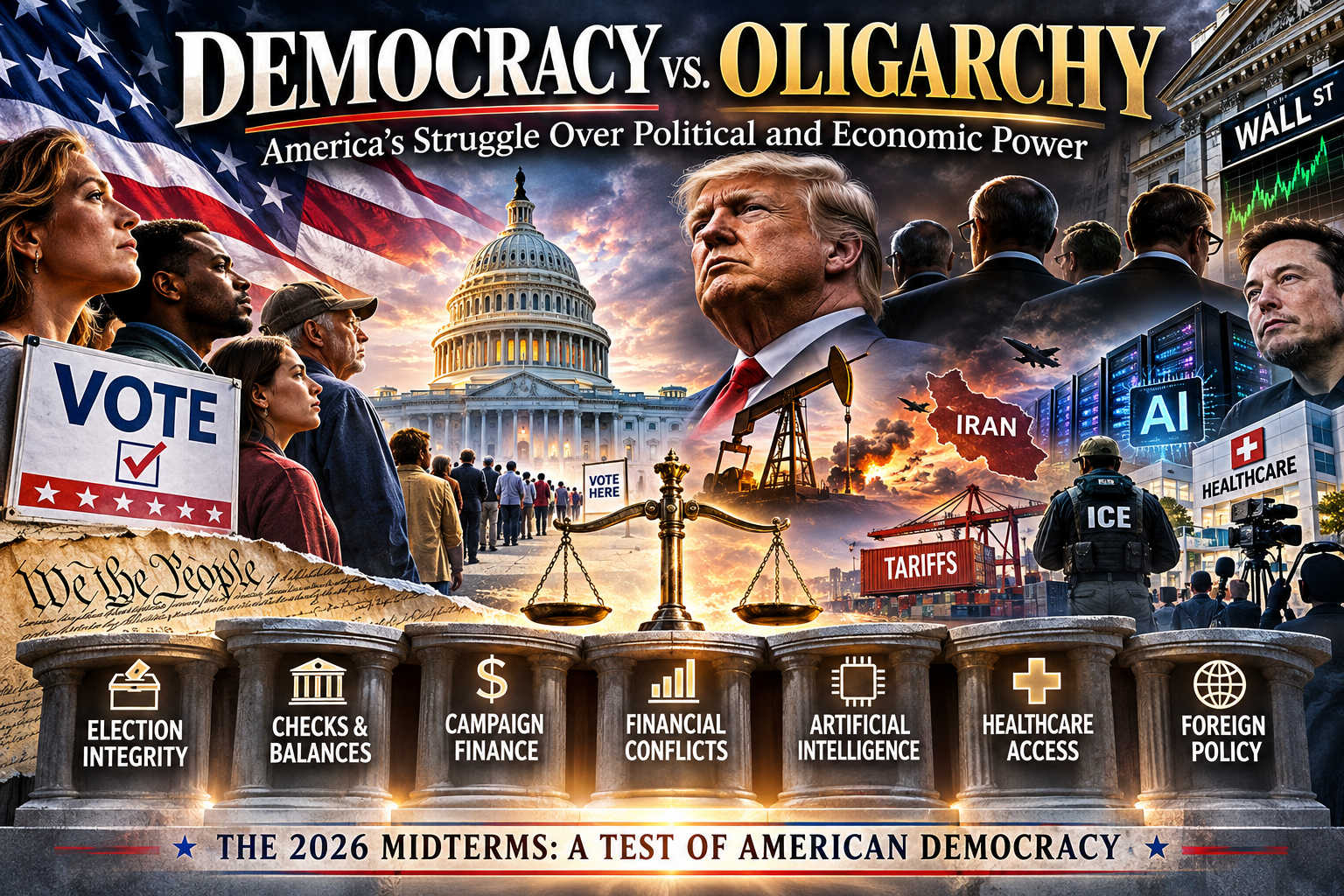
- An examination of the 2026 midterm elections, presidential authority, financial influence, institutional accountability, and the future of American democracy.
Democracy, Oligarchy, and the Markets: America's Struggle Over Political and Economic Power
An examination of the 2026 midterm elections, presidential authority, financial influence, institutional accountability, and the future of American democracy.
The United States entered its 2026 midterm elections confronting questions that extended far beyond which political party would control Congress.
Gasoline prices, the conflict with Iran, artificial intelligence, data centers, healthcare, immigration enforcement, and the cost of living dominated public discussion. Beneath those issues lay a more fundamental debate: Who exercises power in American society, who benefits from government decisions, and what mechanisms remain available to hold that power accountable?
The accompanying dialogue presents a sweeping critique of President Donald Trump's second administration. It argues that the administration has challenged democratic institutions, expanded executive authority, weakened traditional checks and balances, and allowed concentrated private wealth to exercise disproportionate political influence.
Those allegations deserve careful examination. Some concern documented government actions and judicial disputes. Others involve contested interpretations of presidential motives, the consequences of policy decisions, or accusations of financial misconduct that require independent evidence.
The central question is larger than any single administration: Can a democratic government remain accountable to its citizens when political authority, corporate influence, and financial-market power become increasingly interconnected?
This question connects the 2026 election debate to a longer historical transformation in which financial markets have evolved from reacting to government decisions into helping shape the decisions governments make.
1. The 2026 midterms: A test of constitutional checks and balances
The November 3, 2026, midterm elections produced a consequential change in American political power.
As of November 4, major news organizations, including the Associated Press and Reuters, projected that Democrats had won control of both the House of Representatives and the Senate. Several races remained unresolved, and official certification was still pending.
The result matters because the United States Constitution deliberately divides political authority among three branches of government.
Congress writes legislation, appropriates funds, conducts oversight, and possesses impeachment powers. The president executes federal law and directs the executive branch. Federal courts resolve legal disputes and determine whether government actions comply with the Constitution and applicable laws.
These arrangements were designed to prevent political authority from becoming concentrated in a single institution.
Yet constitutional safeguards depend on more than their existence in written law. They also depend on officeholders exercising their authority, courts retaining independence, and government officials respecting enforceable limits.
During Trump's second administration, critics argued that Republican congressional majorities had been reluctant to challenge presidential decisions involving executive spending, tariffs, immigration enforcement, and foreign military operations.
Administration supporters countered that the president was exercising authority granted by the Constitution and Congress, and that many executive actions were necessary to implement the policies voters supported in 2024.
The 2026 election changes the institutional relationship. A Congress controlled by the opposition party has greater incentives and opportunities to conduct investigations, challenge spending decisions, demand testimony, and scrutinize executive conduct.
That does not mean every allegation against the administration is established, or that every investigation will substantiate wrongdoing. It means an additional mechanism of political accountability becomes available.
2. Election administration: The conflict between Washington and the states
One of the dialogue's most concrete allegations concerns the federal government's attempts to obtain voter-registration records from state governments.
The Constitution establishes a decentralized election system in which states administer elections subject to federal constitutional protections and laws.
Beginning in May 2025, the Department of Justice sought extensive voter-registration information from states, including information that was not ordinarily available to the public.
The administration maintained that the information was necessary to enforce federal election laws, maintain accurate voter rolls, and prevent improper voting.
State officials opposing the requests raised concerns about federal authority, privacy, data security, and the potential creation of centralized voter-information systems.
DOCUMENTED LEGAL DEVELOPMENTS
31 | 27 |
| Federal lawsuits reported by October 26, 2026 | Cases the administration had lost at that point |
Figures reported by CBS News on October 26, 2026; subsequent appeals or rulings may change individual case outcomes.
The National Conference of State Legislatures also documented numerous dismissals and continuing appeals. Its October 8 analysis described the requests as a significant departure from the Justice Department's historically limited involvement in state voter-list maintenance.
This dispute demonstrates a fundamental constitutional tension.
The federal government has legitimate responsibilities to enforce voting-rights and election laws. States simultaneously possess legal responsibilities to administer elections and protect voter information.
The question is where federal oversight ends and an intrusion into state authority begins.
The dialogue interprets these lawsuits as part of an effort to influence elections. That is a serious allegation about intent. The litigation establishes the administration's extensive pursuit of voter data and repeated legal setbacks, but does not, by itself, prove an intention to manipulate election results.
Gerrymandering and political representation
The dialogue also raises allegations of White House pressure on Republican-controlled states to redraw congressional districts.
Gerrymandering, the drawing of electoral boundaries to advantage a political party or group, has existed throughout American history.
Partisan redistricting is distinguishable from racial discrimination in district design. Federal law and constitutional protections restrict racial discrimination, while the Supreme Court has generally treated claims of purely partisan gerrymandering as outside federal judicial review.
Whether particular 2025–2026 redistricting efforts violated voting-rights protections requires examination of the maps, communications, legislative records, and relevant court decisions.
The broader democratic concern is straightforward: when politicians can substantially influence which voters will determine their electoral futures, representative accountability may weaken.
3. Executive power and the historical pattern of democratic erosion
The dialogue compares the Trump administration's governing methods with those associated with leaders in Hungary and Russia. Such comparisons are common in political science, but they require precision.
Democratic erosion does not necessarily occur through the immediate cancellation of elections or the formal abolition of a constitution. It can also involve gradual changes to the institutions that make elections meaningful.
Political scientists examine developments such as the politicization of civil-service appointments, weakened legislative oversight, pressure on independent journalism, reduced judicial independence, restrictions on political competition, and the use of government institutions against opponents.
Hungary and Russia have different political histories and institutional conditions. They should not be treated as identical models, nor should every controversial American executive action automatically be equated with developments in either country.
The relevant question is whether particular policies weaken the practical ability of institutions and citizens to constrain government power.
Institutions under pressure
The dialogue identifies several areas of concern:
Civil service: Whether changes to federal employment protections increase political control over administrative functions.
Universities and scientific institutions: Whether funding and regulatory decisions interfere with academic independence.
Journalism: Whether government licensing, regulatory authority, or legal pressure is used to discourage critical reporting.
Public health: Whether changes to scientific leadership and health policy undermine evidence-based decision-making.
Immigration enforcement: Whether federal enforcement agencies operate with sufficient transparency, proportionality, and independent oversight.
Each issue requires its own factual and legal assessment.
Executive agencies are not independent of democratic government. Presidents are entitled to establish lawful policy priorities and appoint officials consistent with governing statutes. But political accountability also requires mechanisms that distinguish lawful policy direction from retaliation, arbitrary enforcement, and misuse of public authority.
4. January 6 and the question of democratic continuity
The concerns raised in the dialogue cannot be separated from the events following the 2020 presidential election.
After losing that election, Trump and his allies pursued numerous efforts to contest or reverse the outcome. These included litigation, pressure on state officials, disputes over electoral certification, and efforts involving alternate slates of electors.
On January 6, 2021, a crowd attacked the United States Capitol while Congress was meeting to certify the Electoral College results.
The attack interrupted the certification proceedings, which later resumed.
The House January 6 committee concluded that Trump had played a central role in efforts to overturn the election. Trump rejected the committee's conclusions and disputed allegations that he had acted unlawfully.
The historical significance lies in the challenge to the peaceful transfer of power, a defining practice of constitutional democracy.
An important distinction remains: the constitutional system ultimately completed the certification process and the transfer of presidential authority occurred.
The 2026 midterm elections therefore provide another opportunity to examine the resilience of American electoral institutions, including whether votes are counted, lawful results are certified, and the incoming Congress is seated according to established procedures.
5. The intersection of political power, financial markets, and personal enrichment
One of the dialogue's most consequential allegations is that the administration's economic decisions created opportunities for politically connected individuals to profit from financial-market movements.
This connects directly to a broader historical development: the changing relationship between government and financial markets.
For much of modern economic history, financial markets were understood primarily as responding to government decisions. Tax legislation, interest-rate policy, regulations, military actions, and public spending influenced corporate earnings and asset valuations.

Today, the relationship is visibly bidirectional.
Governments influence financial markets, while financial markets influence government decisions through borrowing costs, investment flows, inflation expectations, and political pressure.
This creates an important distinction between three different phenomena.
Market influence: Government policy affects asset prices, and policymakers respond to financial conditions. This is a normal feature of modern economies.
Conflicts of interest: Government officials maintain financial relationships or interests that could benefit from decisions they make. Such conflicts require disclosure, safeguards, and appropriate oversight.
Corrupt financial conduct: Officials or associates deliberately exploit confidential government information, misuse public authority, or coordinate decisions to obtain improper financial benefits. These are allegations requiring specific evidence.
The dialogue suggests the third phenomenon may be occurring. That allegation cannot be established merely by observing profitable trades near government announcements.
Iran, oil prices, and the financial consequences of war
The relationship between geopolitical conflict and oil prices is especially important.
Since the 1973 oil embargo, conflicts in major petroleum-producing regions have repeatedly influenced global energy prices.
The Iranian Revolution, Iran–Iraq War, Gulf War, and subsequent confrontations involving Iran demonstrate how military developments can alter expectations about petroleum supply.
Threats to the Strait of Hormuz are particularly consequential because the waterway is a major route for internationally traded petroleum.
The financial mechanism is straightforward:
Military threats or escalation > Greater perceived supply risk > Potential increase in oil prices and market volatility > Higher energy costs, inflation pressure, and potential trading gains or losses > Government responses and diplomatic developments can change market expectations again.
A military threat can increase oil prices without immediately reducing physical supplies. Conversely, credible diplomatic progress can reduce the risk premium embedded in petroleum contracts.
Investors who anticipate these developments correctly may profit. Others may experience substantial losses.
This raises an accountability question: should officials involved in decisions capable of moving financial markets face stronger restrictions on personal investments and financial relationships?
The answer involves balancing legitimate private financial activity against the public's interest in preventing misuse of confidential information and government authority.
The difference between market reaction and market manipulation
The image discussed earlier in this conversation depicts a cycle of military escalation, rising oil prices, profitable selling, diplomatic de-escalation, falling prices, and renewed buying.
The economic sequence is plausible as a hypothetical trading strategy.
But establishing intentional manipulation would require evidence of trading activity, advance knowledge, financial beneficiaries, communications, and improper coordination.
Without that evidence, the image is best understood as political commentary illustrating a potential vulnerability in the relationship between government authority and financial markets.
6. Elon Musk, government restructuring, and conflicts of interest
The dialogue also raises questions about Elon Musk's involvement in federal administrative restructuring.
The underlying institutional concern is the relationship between private commercial interests and temporary government authority.
When a business executive participates in decisions affecting agencies that regulate industries in which that executive operates, several questions arise.
- Who determines whether a conflict of interest exists?
- Which officials have authority to approve or reject proposed changes?
- Are decisions documented and subject to independent review?
- Can affected individuals challenge decisions through established legal procedures?
The answers matter regardless of the political affiliation of the executive or administration involved.
The dialogue also attributes severe humanitarian consequences to reductions in foreign assistance.
Abrupt interruptions to food distribution, disease prevention, medical treatment, and humanitarian logistics can create substantial risks, especially where recipients depend on continuing assistance.
However, the assertion that particular decisions caused a specific number of deaths requires independently documented mortality estimates and a defensible causal methodology.
Projected deaths, observed deaths, and deaths directly attributable to an identifiable policy are not interchangeable measures.
The larger policy question is whether restructuring government programs is accompanied by adequate analysis of financial savings, service disruptions, legal obligations, and human consequences.
7. Healthcare, taxation, and the distribution of economic benefits
The dialogue describes a political economy in which wealthy individuals receive substantial benefits while lower-income Americans experience reductions in public services.
This argument concerns distribution: who receives the gains from economic policy, and who bears its costs?
Tax reductions can increase disposable income, investment returns, and incentives for certain forms of economic activity. Their distribution depends on the legislation's design and the structure of the tax system.
Reductions in public healthcare spending can reduce government expenditures, but may also affect insurance coverage, provider finances, and access to care.
These outcomes should be assessed using measurable indicators, including household income, effective tax rates, insurance enrollment, medical debt, health outcomes, and federal deficits.
A policy that improves aggregate financial-market performance does not necessarily improve living standards for every population group.
Likewise, a policy that reduces public spending is not necessarily economically beneficial if the reduction creates larger costs elsewhere.
The appropriate comparison is not simply government spending versus government savings, but the full economic and social consequences of the decision.
8. Artificial intelligence and the emerging concentration of economic power
Artificial intelligence introduces another dimension to the debate.
Unlike earlier technological transformations, modern AI development depends heavily on access to computational infrastructure, specialized semiconductor manufacturing, electricity, large datasets, and substantial capital investment.
These requirements can concentrate technological capabilities among companies and governments able to finance them.
Data centers consequently become more than commercial infrastructure. They become strategically important assets affecting energy demand, economic development, national security, and technological competitiveness.
This raises several governance questions.
Who controls the infrastructure? Who determines how AI systems are deployed? Who owns the information used to develop and operate them? Who is accountable when automated systems cause harm? And how can citizens meaningfully challenge decisions increasingly influenced by algorithms?
The dialogue characterizes the AI industry as unable to control its models. That is too broad to treat as a settled factual conclusion.
AI systems vary considerably in their capabilities, safeguards, reliability, and risks. Nonetheless, transparency, independent evaluation, accountability, and the concentration of computational resources remain legitimate public-policy concerns.
There is also a connection to the political economy of financial markets.
As technology companies become more influential in stock indexes, infrastructure investment, and national productivity expectations, their economic importance can translate into greater access to policymakers.
That influence is not automatically improper. The democratic question is whether government decisions remain subject to transparent public-interest standards rather than being determined primarily by the preferences of dominant corporations.
9. Campaign finance and the rise of concentrated political influence
Perhaps the dialogue's most fundamental argument concerns the influence of wealth on American democracy.
The United States has a campaign-finance system in which political parties, candidates, political action committees, independent organizations, corporations, unions, and wealthy individuals can participate through different legally regulated channels.
The Supreme Court's 2010 decision in Citizens United v. Federal Election Commission prohibited certain restrictions on independent political expenditures by corporations and unions. The decision did not eliminate contribution limits for direct donations to candidates, nor did it permit coordination that would turn legally independent spending into an unlawful contribution.
Supporters of the decision emphasize political expression and the First Amendment. Critics argue that allowing extensive independent spending gives wealthy participants disproportionate opportunities to shape political debate.
The distinction between formal voting equality and practical political influence is important.
Every eligible voter has an equal vote in an election for a particular office. But citizens do not possess equal financial resources to purchase advertising, fund political organizations, lobby officials, or maintain relationships with policymakers.
The resulting disparity raises questions about whose interests receive attention between elections.
The dialogue describes this as a movement toward oligarchy, a political condition in which a relatively small and powerful group exercises disproportionate influence.
Whether that term accurately describes the United States is contested. Evaluating the claim requires evidence concerning political access, campaign spending, policy outcomes, institutional independence, and the capacity of ordinary citizens to influence government decisions.
What can be said is that the concentration of wealth creates a continuing challenge for systems built around political equality.
10. What Congress can do: Restoring institutional accountability
The incoming Congress will possess significant constitutional authority, although the exercise of that authority will remain subject to procedural rules, judicial review, and the separation of powers.
Several areas of reform emerge from the dialogue.
These proposals are not interchangeable. Each involves different constitutional constraints, implementation costs, and potential trade-offs.
Investigations should also distinguish policy disagreements from legal violations. Congressional oversight is most credible when it applies consistent standards to officials regardless of party.
11. The 2026 election and the resilience of American democracy
The dialogue ends by emphasizing the importance of citizens exercising their right to vote despite concerns about institutional instability.
The November 3 election provides evidence that electoral competition continues to function as a mechanism for changing political power.
According to the Associated Press, Democrats gained control of both chambers of Congress, including at least seven Senate seats previously held by Republicans. AP voter polling identified concerns about living costs, the Iran war, tariffs, and congressional oversight among the issues influencing the electorate.
These results demonstrate a significant electoral shift. They do not, by themselves, establish that every voter endorsed a particular interpretation of the administration or its conduct.
Americans vote for different reasons, and elections typically reflect multiple economic, social, political, and local considerations.
Nor does a projected electoral victory immediately transfer legislative authority. Results must be certified, legal challenges resolved where applicable, and newly elected members sworn into office.
Delays in counting or certification are not inherently evidence of manipulation. Election administration involves legally prescribed processes for verifying ballots, reconciling results, and resolving disputes.
Specific allegations of interference should be evaluated against evidence rather than assumptions.
Nevertheless, the ability of voters to change congressional control is a meaningful constitutional safeguard.
12. The larger historical transformation: From representative government to market-dependent governance?
The discussion brings together three developments that are often examined separately.
The first is the expansion of executive authority, particularly in matters involving national security, regulation, immigration, and economic policy.
The second is the concentration of private economic power through financial markets, large corporations, political spending, and technological infrastructure.
The third is the increasing interdependence of government decisions and market reactions.
These developments can reinforce one another.
A government decision can move financial markets. Market movements can affect inflation, investment, and public confidence. Financially powerful participants can use their resources to seek access to government. Government officials may then face incentives to consider those interests when designing policy.
None of this establishes that markets have replaced democratic institutions or that every political decision is financially motivated.
But it identifies a structural vulnerability: economic power can become political influence, and political influence can produce economic advantages that further concentrate power.
This is not unique to the Trump administration, nor did it begin in 2025.
American history includes repeated conflicts over banking power, industrial monopolies, railroad corporations, political machines, campaign financing, and government favoritism.
The Progressive Era, antitrust movement, New Deal reforms, and subsequent financial regulations all reflected attempts to address relationships between private wealth and public authority.
The contemporary version involves global capital markets, artificial intelligence, digital communications, and financial instruments capable of reacting to political announcements almost instantaneously.
The challenge is therefore both historical and technological.
Democratic institutions developed in an earlier economic environment must now operate within a system in which information, capital, and political influence can move across national boundaries at extraordinary speed.
Conclusion: The future of democracy depends on more than elections
The 2026 midterms are a significant moment in American constitutional government, but elections alone cannot resolve every underlying problem.
Democracy depends on an ongoing relationship between political authority and public accountability.
It requires lawful elections, independent courts, meaningful legislative oversight, freedom of expression, transparent government, and institutions capable of investigating misconduct without regard to political affiliation.
It also requires citizens to distinguish documented facts from allegations, legitimate policy disagreements from violations of law, and financial-market reactions from evidence of deliberate manipulation.
The dialogue presents an urgent argument that American institutions have been weakened by concentrated executive and private power. That interpretation should be tested against evidence, including the administration's legal defenses, judicial findings, legislative records, and independently documented outcomes.
The election results demonstrate that Americans retain the ability to alter the composition of Congress through the ballot box.
What follows will test how effectively the newly elected legislature exercises its constitutional responsibilities.
The larger question extends beyond Democrats and Republicans, Donald Trump, or any particular election.
Can the United States preserve a system in which economic power remains accountable to democratic institutions, rather than allowing democratic institutions to become increasingly dependent on economic power?
The answer will be determined not by one election, but by the durability of constitutional safeguards, the transparency of public decisions, and the continuing capacity of citizens to participate in their own government.
Sources and further reading
The following provide starting points for independently examining the article's principal factual issues:
Associated Press — November 2026 midterm results and congressional implications
National Conference of State Legislatures — Federal requests for voter lists
U.S. Department of Justice — Administration's explanation of voter-list lawsuits
Editorial note: November 4, 2026: This article is an independently developed historical and institutional analysis based on the supplied dialogue and the preceding discussion. It is not a verbatim transcript or an endorsement of every allegation made by the author. Election projections remain subject to official certification. Specific allegations involving corruption, financial trading, unlawful conduct, and policy-related deaths require separate evidentiary examination.


No Comments
Signup or login to leave a comment