
Blog
- An Intelligence Hypothesis Examining Donald Trump, Alnur Musayev, Russia's Long War Against the West, and Vladimir Putin's September 2026 Speech
Introduction: The War That May Have Changed Front Lines
For more than three decades, Russia has sought to regain influence lost after the collapse of the Soviet Union.
Its methods have included diplomacy, military intervention, economic leve
rage, espionage, cyber operations, political influence, and information warfare.
The United States has historically been the principal obstacle to Russian ambitions in Europe. American military power, NATO leadership, economic sanctions, intelligence capabilities, and support for European governments have limited Moscow’s ability to reshape the continent’s security arrangements.
But what happens when Russia no longer perceives the United States as its principal obstacle?
That question emerges from an unusual convergence of events and allegations.
Former Kazakh intelligence chief Alnur Musayev alleges that Donald Trump was recruited by Soviet intelligence in 1987 and subsequently became a strategic asset of Russia.
Trump’s political career includes decisions and statements that have benefited Russian strategic interests, alongside other decisions that have imposed substantial costs on Moscow.
And in September 2026, Vladimir Putin delivered an approximately eight-minute response to a reporter’s question about German politics that appeared to concentrate on Europe’s remaining political and economic resistance rather than on confrontation with the United States.
Taken separately, these observations invite different interpretations.
Taken together, they raise a larger intelligence question:
Has Russia’s information warfare campaign reached a stage in which Putin believes American resistance has been sufficiently weakened that the decisive struggle has shifted to Europe?
This investigation does not assume that conclusion.
It tests it.
PART I
The Strategic Objective: Defeating an Alliance Without Defeating Its Armies
The Soviet Union collapsed in December 1991.
The institutions of Soviet government disappeared, but Russia retained many of the security concerns, intelligence traditions, geopolitical ambitions, and strategic capabilities associated with its predecessor.
The Cold War ended as a formal confrontation between two political systems. Competition over European security, influence, and international power continued.
From Moscow’s perspective, NATO enlargement brought a military alliance historically organized against the Soviet Union closer to Russian territory.
From the perspective of Poland, Estonia, Latvia, Lithuania, and other countries, NATO membership offered protection against renewed domination by Moscow.
Both perspectives are essential to understanding the conflict.
Russia’s intelligence services also inherited Soviet traditions of active measures: operations intended to influence foreign political systems, manipulate information, cultivate useful relationships, and exploit divisions within adversarial societies.
The strategic attraction of such operations is straightforward.
An adversary does not necessarily need to defeat NATO militarily if it can weaken the political willingness of NATO members to act together.
An alliance depends on more than weapons.
It depends on confidence, shared interests, political legitimacy, economic cooperation, and the expectation that members will honor their commitments.
If those foundations deteriorate, military strength can remain substantial while collective political effectiveness declines.
This creates a potential strategic objective:
Reduce the willingness of Western governments to resist Russian objectives without requiring direct military confrontation with the entire alliance.
That objective is consistent with known influence-warfare methods. Whether Russia has achieved it is a separate question.
PART II
The American Question: Why Donald Trump Matters
Donald Trump’s relationship with Russia has attracted scrutiny for decades.
In 1987, Trump visited Moscow while exploring business opportunities.
That same year, he publicly criticized the financial burden of American security commitments to allies.
Decades later, Russia conducted an extensive interference campaign during the 2016 American presidential election.
American intelligence assessments concluded that Russian leadership sought to influence the election in Trump’s favor.
The investigation led by Special Counsel Robert Mueller documented extensive Russian interference but did not establish that the Trump campaign conspired or coordinated with the Russian government in that operation.
The bipartisan Senate Intelligence Committee subsequently documented significant counterintelligence concerns involving people associated with Trump’s campaign.
These findings establish that Russia attempted to influence American politics.
They do not establish that Trump was recruited as a Soviet or Russian intelligence agent.
That distinction is fundamental.
Three competing hypotheses
To examine Trump’s relationship with Russian strategic interests, we apply Analysis of Competing Hypotheses, or ACH, associated with CIA analyst Richards Heuer.
Rather than accumulating evidence that supports a preferred conclusion, ACH examines evidence that is inconsistent with competing explanations.
H1 — Independent Alignment
Trump’s positions arise primarily from his longstanding political beliefs, business interests, negotiating style, and domestic political incentives.
Russian leaders recognize that some of these positions serve their interests and attempt to exploit the opportunities.
No covert relationship is necessary.
H2 — Cultivated Influence
Soviet or Russian intelligence identified Trump as potentially useful and deliberately cultivated relationships, access, or vulnerabilities over time.
Such cultivation may have influenced his behavior without formal recruitment or operational control.
H3 — Covert Control
Trump entered a knowing covert relationship with Soviet or Russian intelligence, or became subject to coercion or direction through compromising information, financial leverage, or another mechanism.
This hypothesis includes Musayev’s allegations.
The hypotheses differ in what they require.
H1 requires no covert intelligence relationship.
H2 requires evidence of deliberate cultivation and, for claims of effective influence, evidence connecting cultivation to outcomes.
H3 requires substantially stronger evidence of recruitment, coercion, or operational direction.
They are not entirely mutually exclusive. Independently formed political beliefs can coexist with foreign cultivation.
Nevertheless, the distinctions allow us to test how far the evidence reaches.
PART III
The Musayev Allegations: A Possible Explanation, Not an Established Fact
Alnur Musayev is a former senior Soviet and Kazakh security official who twice served as chairman of Kazakhstan’s National Security Committee.
His career and subsequent political conflict with Kazakhstan’s leadership are documented.
In 2008, he survived an attack in Vienna that Austrian authorities investigated as an attempted kidnapping.
The incident demonstrates that Musayev’s intelligence and political history involved serious conflicts extending beyond Kazakhstan.
It does not establish the truth of his allegations concerning Donald Trump.
In February 2025, Musayev publicly alleged that Soviet intelligence recruited Trump in 1987 under the codename Krasnov.
In a subsequent interview, he expanded that account.
He alleged that Trump had become a Russian strategic asset, that Moscow possessed extensive compromising material, and that Putin could exercise influence over Trump’s decisions.
If authenticated, such claims would profoundly change the interpretation of modern American foreign policy.
But extraordinary consequences do not establish factual accuracy.
The unresolved evidentiary problems
Musayev has not publicly produced an authenticated recruitment file, operational record, or independently corroborated firsthand account establishing Trump’s alleged recruitment.
His description of his own 1987 assignment also conflicts with published biographical accounts placing him in the Soviet Ministry of Internal Affairs during that period.
A classified assignment or interagency secondment could potentially explain the discrepancy, but no documentation resolving it has been presented.
His description of the KGB’s Sixth Directorate raises additional questions about the division of responsibilities between Soviet economic counterintelligence and foreign intelligence.
These are not automatic disproofs.
They are gaps that must be addressed before his testimony can establish H3.
What Musayev’s allegations contribute
Musayev’s account provides a specific explanation for a broader observable pattern.
He does not merely argue that Russian interests have benefited from certain American decisions.
He alleges that the pattern results from a longstanding covert intelligence relationship.
That is a testable claim in principle.
The relevant evidence would include authenticated service records, recruitment documentation, independently corroborated intelligence testimony, or financial records demonstrating leverage linked to specific decisions.
Until such evidence emerges, Musayev’s account remains an allegation rather than a verified explanation.
PART IV
The Contradictions: Why Trump’s Record Cannot Be Reduced to Russian Control
An intelligence hypothesis must account for evidence that contradicts it.
Trump’s first administration authorized Javelin antitank weapons for Ukraine.
It expelled 60 Russian personnel following the 2018 poisoning of Sergei Skripal in Britain.
It withdrew from the Intermediate-Range Nuclear Forces Treaty.
It also imposed or maintained sanctions against Russian individuals and institutions.
These actions imposed costs on Moscow.
They complicate any explanation suggesting that Trump consistently acted under Russian direction.
A covert-control hypothesis could propose that American institutions constrained Trump, that competing objectives influenced particular decisions, or that Moscow tolerated some unfavorable actions.
But those possibilities cannot simply be assumed.
They require evidence.
Otherwise, the hypothesis becomes impossible to disprove.
Every action favorable to Russia would demonstrate control, while every action unfavorable to Russia would supposedly demonstrate concealment.
That is not a reliable intelligence method.
What the contradictions tell us
The available record supports the conclusion that Trump’s relationship with Russia has been politically and strategically unusual.
It does not establish why.
His conduct can be interpreted through several competing mechanisms: independent ideology, transactional diplomacy, personal political incentives, cultivated influence, or covert leverage.
The first three require fewer undocumented assumptions.
The latter two remain legitimate investigative questions but require additional evidence.
The purpose of this analysis is not to eliminate those questions.
It is to determine what evidence would distinguish their answers.
PART V
The Wider Battlefield: Europe as the Next Strategic Center
The investigation changes when we move beyond Trump’s personal relationship with Russia.
Even if H1 proves correct, even if Trump acts entirely from independently formed convictions, Russia may still benefit from the consequences.
A foreign intelligence service does not need to control a political leader to exploit his decisions.
It can identify favorable policies, amplify supportive narratives, cultivate relationships with aligned political movements, and use existing disagreements to weaken opposing coalitions.
That distinction is essential.
The strategic result may resemble the outcome of covert influence even when the underlying mechanism is ordinary domestic politics.
The domino hypothesis
Consider the Western security system as a network of mutually reinforcing political commitments.
American leadership supports NATO’s credibility.
NATO supports the security of European members.
European unity supports sanctions, economic resilience, military assistance, and resistance to coercive pressure.
If confidence in American leadership weakens, European governments face greater uncertainty.
If major European economies become politically divided, collective action becomes harder.
If frontline states lose confidence in collective defense, Russia may gain additional bargaining leverage.
The proposed sequence is:
Reduced American commitment → increased European uncertainty → weakened political cohesion → greater Russian strategic leverage.
This is the domino hypothesis.
It is a possible mechanism, not a demonstrated sequence of Russian victories.
Germany’s significance
Germany occupies a central position in Europe’s economy, industrial capacity, and political decision-making.
Its energy relationship with Russia once created substantial mutual commercial benefits but also generated strategic vulnerabilities.
After Russia’s full-scale invasion of Ukraine in 2022, Germany and other European states faced major economic and political costs associated with reducing dependence on Russian energy.
Those costs became subjects of domestic political debate.
Moscow has a strategic interest in how German voters interpret them.
If economic hardship is attributed primarily to the decisions of German or European leaders rather than to Russia’s conduct, political pressure for accommodation with Moscow may increase.
That does not mean every critic of German energy policy serves Russia.
It means that genuine grievances can become useful material for foreign influence campaigns.
The Baltic states
Estonia, Latvia, and Lithuania occupy a different strategic position.
Their historical experience of Soviet rule makes Russian coercion a central security concern.
Their NATO membership places them within the alliance’s collective-defense framework.
If Russia seeks to test the credibility of NATO commitments, the Baltic region is strategically significant.
But calling the Baltic states the “last dominoes” would imply that their resistance is already collapsing.
The available evidence does not establish that.
A more defensible formulation is that Germany and the Baltic states represent different remaining tests of Western cohesion: Germany through political and economic resilience, and the Baltic states through deterrence and collective-defense credibility.
PART VI
The Final Test: Putin’s September 2026 Speech
The most revealing element of this investigation may not be Musayev’s allegations.
It may be what Vladimir Putin chose to emphasize in September 2026.
In an approximately eight-minute response to a reporter’s question about German politics, Putin presented a sweeping interpretation of the post-Cold War international order.
He discussed Western triumphalism after the Soviet collapse.
He accused Western governments of making systemic strategic errors.
He presented NATO enlargement as a source of Russian insecurity.
He framed the conflict in Ukraine through the language of Western provocation.
He criticized European energy decisions.
He invoked former German Chancellor Helmut Kohl as an example of an earlier generation that understood the value of cooperation with Moscow.
And he returned to dissatisfaction among German voters.
The speech had a coherent structure.
It began with German political frustration, moved through decades of geopolitical grievances, and ended by presenting contemporary European dissatisfaction as evidence of Western strategic failure.
This was not merely a historical explanation.
It was a political argument about the legitimacy of Europe’s current leadership and the costs of resisting Russia.
What Putin said
Putin’s narrative presented Europe’s problems as consequences of Western decisions.
The implication was that Russia’s conduct should be understood primarily as a response to those decisions.
In this construction, the central problem is not Russian expansion or coercion.
It is Western leadership.
That framing encourages audiences to reconsider whether their governments have accurately identified the source of their insecurity.
It also offers a political alternative: renewed accommodation with Moscow.
What Putin did not say
The speech is especially interesting for its relative lack of emphasis on the United States as an immediate obstacle.
Historically, Washington has been the central organizing force behind Western military and economic resistance to Moscow.
Yet Putin’s immediate political argument concentrated on Europe.
Germany’s leadership, German voters, European energy choices, and the consequences of NATO enlargement occupied the foreground.
The United States remained present within his historical account of Western policy, but it was not the principal contemporary target of his criticism.
Donald Trump was not the organizing subject of the speech.
This omission deserves examination.
Why would Putin concentrate on Europe’s political vulnerabilities rather than directly challenge the American president?
There are several possible explanations.
PART VII
Three Hypotheses Explaining Putin’s Speech
P1 — Audience-Specific Messaging
Putin was responding to a question about German politics.
His focus on Germany and Europe may therefore reflect the subject of the question rather than a broader judgment that the United States has ceased to be a strategic threat.
Under this explanation, the omission of Trump is not especially revealing.
The speech is tailored to its immediate audience.
Evidence supporting P1: The response begins and ends with German politics.
What would weaken P1: Evidence that Putin systematically deemphasizes American resistance across unrelated speeches, internal strategic statements, and diplomatic initiatives.
P2 — Perceived Strategic Opportunity
Putin may believe that changes in American policy have created an opportunity to weaken Western unity.
Under this explanation, the United States remains powerful, but Moscow perceives Washington as less willing to organize sustained resistance to Russian objectives.
Germany and other European governments therefore become more important immediate targets for political persuasion and strategic pressure.
This hypothesis does not require Trump to be a Russian intelligence asset.
It requires only that Moscow perceive American policy as creating opportunities.
Evidence supporting P2: A sustained shift in Russian messaging and diplomatic activity toward exploiting disagreements between Washington and European governments.
What would weaken P2: Evidence that Moscow continues to regard American policy as the principal obstacle to its objectives and treats European disagreements as secondary.
P3 — Perceived Strategic Victory
The strongest interpretation is that Putin believes Russia has already achieved a major objective of its information war: substantially reducing America’s willingness or ability to lead unified Western resistance.
Under this hypothesis, Putin’s emphasis on Germany and Europe reflects a shift in what Moscow considers the decisive remaining battlefield.
The United States has not disappeared as a military or economic power.
Rather, Putin may believe its political leadership no longer represents the same obstacle to Russian strategic ambitions.
The struggle would therefore move toward weakening Europe’s remaining centers of resistance.
This interpretation would make the speech resemble a victory narrative.
Not a declaration of military victory.
Not proof of control over Trump.
But a rhetorical expression of confidence that the strategic balance has shifted.
Evidence supporting P3: Russian internal assessments, sustained policy changes, and observable strategic decisions showing that Moscow now treats American resistance as substantially neutralized.
What would weaken P3: Continued Russian prioritization of countering American power, significant American actions imposing costs on Moscow, or evidence that Putin’s European emphasis was primarily rhetorical.
PART VIII
Testing the Victory-Speech Hypothesis
The distinction between P2 and P3 is crucial.
A strategic opportunity is not a strategic victory.
Putin may see divisions within NATO without believing NATO has been defeated.
He may welcome Trump’s policies without believing Trump is controlled.
He may target German voters without believing Germany is about to abandon its commitments.
The speech alone cannot resolve those questions.
Nevertheless, its structure provides a useful analytical signal.
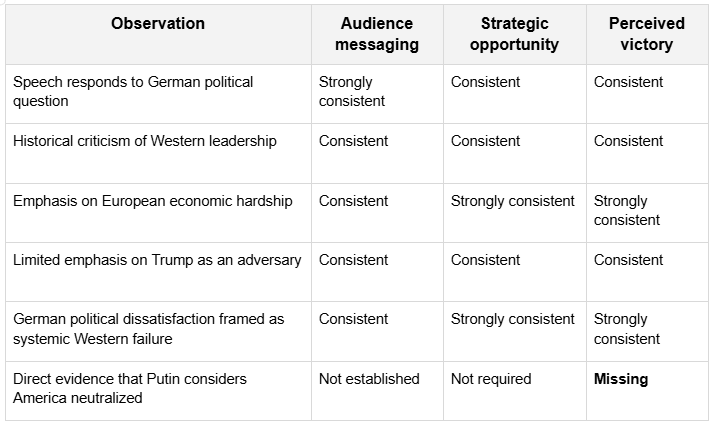
The matrix reveals an important limitation.
Most of the speech’s features are compatible with all three explanations.
Its omissions are suggestive, but they are not sufficiently discriminating to establish P3.
To reach a stronger conclusion, we would need to compare the speech with Putin’s other remarks, Russian strategic documents, diplomatic behavior, and observable responses to American policy.
The strongest hypothesis must explain more than one carefully selected speech.
PART IX
Bringing Musayev Back Into the Analysis
Musayev’s allegations and Putin’s speech address different parts of the same strategic question.
Musayev proposes a mechanism: covert control of the American president.
Putin’s speech may offer an indication of how Moscow perceives the geopolitical environment.
The danger is to combine them circularly.
We cannot argue that Putin’s speech proves Musayev’s allegations and then use Musayev’s allegations to explain the speech.
That would make two uncertain interpretations appear to corroborate one another.
Instead, the two should be tested independently.
If H1 is correct, Putin may still perceive an American president whose independently formed policies create opportunities for Russia.
If H2 is correct, Russian intelligence may have cultivated or exploited relationships that contribute to those opportunities.
If H3 is correct, Moscow may possess a more direct mechanism of influence.
All three could produce a situation in which Putin believes the United States is less likely to obstruct Russian objectives.
That is the key insight.
The geopolitical consequences can be analyzed without first proving the Krasnov allegation.
The decisive distinction
Musayev’s account asks:
Why might Trump act in ways that benefit Russia?
Putin’s speech raises a different question:
What does Moscow believe it has gained from the current geopolitical environment?
The second question may be more answerable through observable evidence.
It directs attention toward Russian decisions, military planning, diplomatic priorities, economic strategy, and influence operations.
Those indicators may reveal whether Putin believes the strategic contest has shifted toward Europe.
PART X
The Last Dominoes: Germany, the Baltics, and the Future of Western Resistance
If Putin perceives American leadership as weakened, the next strategic question is where Russia would concentrate its efforts.
Germany is an obvious candidate for political and economic influence.
It is Europe’s largest economy and an important contributor to European security.
Changes in German policy can affect sanctions, energy arrangements, industrial capacity, and European political coordination.
The Baltic states represent a different challenge.
Their security depends heavily on NATO’s credibility, regional military capabilities, and the willingness of allies to respond collectively to coercion.
A successful attempt to undermine confidence in those commitments could have consequences far beyond the Baltic region.
But Europe is not defenseless.
European governments retain substantial economic resources, military capabilities, intelligence institutions, and independent political agency.
Russia’s war in Ukraine has also strengthened some forms of European cooperation and encouraged higher defense spending.
Finland and Sweden joined NATO in 2023 and 2024, respectively, developments that complicate any claim of an uninterrupted Russian strategic victory.
These facts matter.
A hypothesis about the collapse of Western resistance must account for evidence of Western adaptation and strengthening.
The future of Europe is therefore not a predetermined sequence of falling dominoes.
It is an ongoing contest over deterrence, political cohesion, economic resilience, and public confidence.
CONCLUSION
Putin’s Eight Minutes: A Victory Speech Without a Declaration of Victory?
For decades, Russia has sought to reshape the international environment that emerged after the Soviet collapse.
It has used military force, economic leverage, intelligence operations, diplomatic pressure, and information warfare.
The United States has traditionally been the principal organizer of resistance to those ambitions.
Today, the relationship between Washington, Moscow, and Europe raises difficult questions about whether that strategic arrangement is changing.
Alnur Musayev alleges that the explanation lies in a covert intelligence relationship dating to 1987.
That allegation remains unverified.
Trump’s political record contains decisions favorable to Russian interests and others that imposed costs on Moscow.
Those contradictions prevent a confident conclusion that his conduct results from covert Russian control.
But Putin’s September 2026 speech introduces a different analytical possibility.
What if Moscow no longer believes it needs to defeat American resistance in the same way it once did?
What if Putin sees an American administration whose policies, whatever their underlying motivations, have reduced the obstacles to Russian strategic objectives?
And what if his attention has consequently shifted toward the European governments that remain committed to resisting Russian coercion?
In that context, the speech can be interpreted as something resembling a victory speech.
Not because Putin explicitly declares victory.
Not because he proves that Russia controls Trump.
But because he speaks as though Europe’s difficulties are the consequence of a failed Western strategy and as though the political argument now centers on whether Europeans should continue following that strategy.
The relative absence of Trump as an immediate adversary becomes part of the hypothesis.
Perhaps Putin does not need to attack the American president rhetorically because he no longer sees the current American administration as the principal obstacle to his European objectives.
That possibility deserves serious examination.
Yet it remains a hypothesis, not a finding.
The speech was delivered in response to a German political question. Its European focus may reflect ordinary audience targeting. The United States continues to possess enormous military, economic, and diplomatic power. European resistance has not collapsed.
The evidence therefore supports a narrower conclusion than a declaration of Russian victory.
Putin’s speech is consistent with a perception of strategic opportunity in Europe. It does not, by itself, demonstrate that Moscow believes it has neutralized the United States.
The next phase of this investigation must determine whether Russia’s actual behavior supports that interpretation.
Are Russian operations increasingly concentrated on dividing European governments?
Does Moscow treat American policy as an obstacle to overcome or an opportunity to exploit?
Are European political divisions producing measurable Russian gains?
And does Russia’s strategic planning reveal confidence that American leadership will no longer organize an effective response?
Those are the questions capable of distinguishing a genuine strategic shift from rhetorical performance.
The central issue is ultimately larger than Donald Trump, Alnur Musayev, or a single speech.
It is whether the West’s greatest vulnerability lies not in its military capabilities, but in its political willingness to use them collectively.
The Cold War ended in 1991. The struggle over Europe’s security did not.
And if Putin’s eight minutes were intended to communicate anything beyond his immediate remarks, perhaps the most consequential message was not what he said about Germany.
It was the question raised by what he did not say about America.
Has Putin begun speaking as though the American front of the information war has already been won?
That remains unproven.
But it is now a hypothesis worth testing.
Editorial methodology and evidence note
This investigation combines three distinct source categories: the previously prepared analysis of Putin’s approximately eight-minute remarks; the Musayev interview and biographical investigation; and historical evidence concerning Russian active measures, U.S. foreign policy, and European security.
Statements attributed to Musayev are allegations unless independently corroborated. Interpretations of Putin’s omissions are analytical inferences, not verified statements of his private beliefs. The ACH matrices are qualitative analytical tools, not statistical probabilities.
Before publication, the article should be checked against the original Russian-language recording, the full transcript and surrounding question-and-answer context, official investigative records, and independently verified developments through October 2026.
Information Warfare Magazine | Investigative Analysis

No Comments
Signup or login to leave a comment