
Blog
- AI, Layoffs, and the Hidden Fault Lines of Capitalism
The Machine Economy
AI, Layoffs, and the Hidden Fault Lines of Capitalism
As artificial intelligence (AI) accelerates, automation is no longer a futuristic fantasy — it’s remaking the present. From tech giants pruning workforces to industries reshaping entire business models, the displacement of human labor is a defining moment. But this shift also exposes deeper philosophical tensions in our economic system. What happens when the logic of capitalism collides with the reality of a future where much work can be done by machines?
1. What the Layoff Data Shows (2022–2025)
While no single source tracks all AI‐related layoffs in the U.S., a number of recent reports allow us to draw some plausible trends.
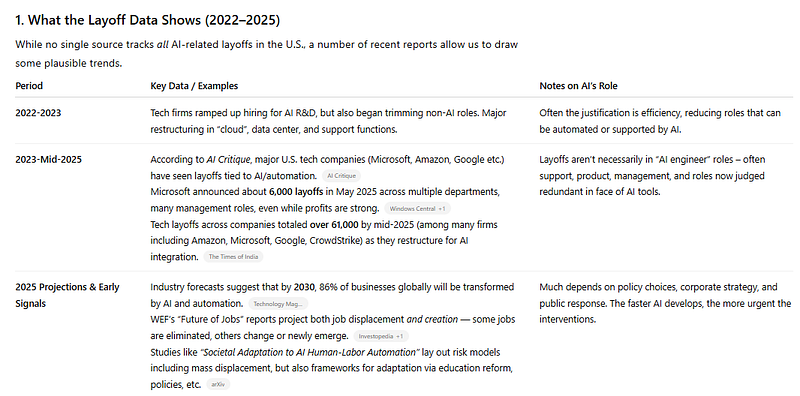
So: layoffs are real, substantial, and increasing. AI is cited directly in some cuts; in others, it’s a supporting factor. The trend is accelerating, even if many jobs are not fully replaced by AI but reshaped.
2. Philosophical Context: Capitalism, Work, and Human Dignity
To understand what this means, we need to examine how capitalism treats work, value, and human purpose.
- Capitalism & Efficiency: At the core of capitalist economies is the drive to reduce costs and increase profits. Automation is a powerful tool in that arsenal. Jobs that cost more in wages or benefits than machines or software can be replaced are under threat. This is not a bug — it’s structurally built in.
- Labor as Identity & Dignity: For many, work is more than a paycheck. It’s identity, status, routine, purpose. Losing work — or seeing one’s role drastically reduced — can erode dignity, psychological well-being, social cohesion.
- Value vs Ownership: AI and automation emphasize ownership of capital (machines, models, algorithms) over labor. The owners of capital extract more surplus. Wealth concentrates further if labor is devalued or replaced. This challenges democratic ideals of fairness.
- Post-Labor Utopias & Critiques: Some theorists imagine a future where machines do much of necessary work (“post-scarcity”) and humans have more time for creativity, care, leisure. Others warn of dystopias: unemployment, social stratification, loss of agency.
- Ethical & Political Imperatives: As Geoffrey Hinton, among others, has warned, AI in its current capitalist embedding threatens to deepen inequality, unless policies are put in place (taxing capital, universal basic income, labor protections). (Business Insider)
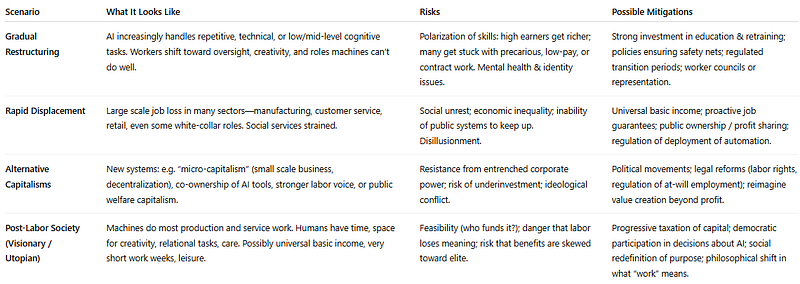
3. Future Projections: What Could Come Next
Based on current data, research, and philosophical frameworks, here are possible futures:
4. What the U.S. Looks Like Compared to Other Countries
Currently, the U.S. is in a less protected position:
- Weak legal labor protections: At-will employment gives employers wide latitude to fire workers.
- Smaller social safety nets: fewer federally mandated paid sick days, parental leave, vacation, etc., meaning job loss is more severe in its consequences.
- Less strong worker representation: unions, worker councils, co-determination are weaker in the U.S. than in parts of Europe.
- More emphasis on market-led change rather than state / community intervention.
This means that when AI-driven layoffs occur in the U.S., there is less buffer. Displaced workers often face fairly immediate economic hardship, housing insecurity, loss of health care, etc., whereas in many European countries these transitions are cushioned.
5. Policy & Ethical Recommendations
- Retraining & Lifelong Learning: government and private sector should invest in training workers whose jobs are at risk, especially mid-skills roles.
- Regulation of AI deployment: require human-in-loop for certain functions; require impact assessments of AI on labor before widespread rollout.
- Universal Basic Income or Job Guarantees: experiments to decouple survival from employment.
- Redistribution & Tax Policy: higher taxation of capital (e.g. profits from AI) to fund social safety nets.
- Labor rights reform: stronger protections against arbitrary dismissals; mandatory severance; paid leave; worker voice in company governance.
- Cultural / Philosophical shift: revaluing non-market work (care, community, creativity) rather than measuring worth solely by economic productivity.
6. Conclusion: A Junction in History
We stand at a crossroads. AI is not inherently good or evil — it amplifies whatever system it’s embedded in. Under unchecked capitalism, it may widen inequality, reduce human dignity, and leave many behind. But with wise policy, philosophical reckoning, and collective action, it also holds the possibility of liberating people from oppressive or pointless labor, giving more people time, security, and autonomy.
The next few years will tell whether we adapt or are crushed by the transition. The question isn’t whether AI will change work — it already is. The question is: how we want it to change, and for whose benefit.
Recent Case Studies
Here are several recent case studies (companies & regions) that concretely illustrate how AI-automation and restructuring are affecting workers, followed by what they suggest about the near-future.
1- xAI (Elon Musk’s AI company) — Data Annotators / Tutors
- In mid-September 2025, xAI laid off at least 500 data annotation / generalist tutor roles. These roles were central to preparing and categorizing raw data used to train its chatbot Grok. (Business Insider)
- The shift: moving away from broad generalist tasks toward specialist AI tutors focused on STEM, finance, safety, etc. (Business Insider)
- Implication: certain AI-adjacent roles that require less specialization are being hit first, especially those involving repetitive or preparatory work.
2- Scale AI — Generative AI Division Restructuring
- Scale AI announced layoffs of ~200 full-time employees (≈14% of staff) plus 500 contractors worldwide under a reorganization in its Generative AI division. (The Verge)
- Reason given: “ramping up GenAI capacity too quickly,” inefficiencies, overlapping roles, bureaucratic layers. (The Verge)
- Also, they reorganized many teams (16 pods → 5) and consolidated go-to-market efforts. (San Francisco Chronicle)
3- Microsoft — Major Workforce Reductions Amid AI Investment
- In July 2025, Microsoft announced cutting nearly 4% of its global workforce, equating to ~9,100 jobs. (Reuters)
- Prior to that, in May, Microsoft also laid off ~6,000 employees. (Windows Central)
- While the company continues making large investments in AI infrastructure, some roles are being deemed redundant or reorganized. (Windows Central)
4- Australia — Banking & Corporate Sector
- Several Australian banks (CBA, ANZ, Westpac, Bank of Queensland) have made significant layoffs while accelerating AI/chatbot tool deployment (for example replacing or reducing roles in customer service and clerical work). (The Guardian)
- These moves highlight that even in economies with somewhat stronger worker protections, corporations are using AI to reduce labor, often gradually. (The Guardian)
5- Chegg (U.S.) — EdTech Effects
- Chegg cut about 22% of its workforce (~248 people), citing reduced demand due to AI tools like ChatGPT and Google AI which substitute for traditional educational help services. (The Times of India)
6- “Tech Layoffs in Silicon Valley” Broad Trend
- According to data (TrueUp’s tech layoff tracker), by 2025 nearly 400 tech companies have announced layoffs affecting ~94,000 employees. Many layoffs are attributed directly or indirectly to automation, AI efficiencies, or shifts in priorities. (Observer)
What the Data Suggests & Projections
- Many companies are reorganizing teams, consolidating AI-related work, cutting roles deemed redundant, particularly in data annotation, content moderation, customer support, clerical work, and other tasks that can be partially automated.
- Layoffs are not limited to small scale; large firms like Microsoft are doing multiple rounds.
- Contractors and lower-tier employees often bear disproportionate cuts.
- AI investment continues even while layoffs happen — suggesting firms are reallocating resources rather than scaling back altogether.
Projections:
- Over the next 3–5 years, more white-collar jobs will be affected (legal, accounting, customer support, HR) as AI tools (LLMs, automation pipelines) reach higher accuracy.
- Some sectors will shrink, while others will transform — new roles in AI oversight, safety, ethics, domain-specific AI tooling will grow.
- Regions with higher exposure to automation risk (manufacturing, routine white-collar) will need substantial adaptation; those with strong social safety nets and retraining programs may fare better.
Philosophical Reflections & Implications
These case studies illuminate deeper tensions at the intersection of AI, automation, and the moral foundations of work, capitalism, and society.
- Capitalism’s Efficiency Imperative vs Human Cost
Under capitalist logic, profits, efficiency, and cost reduction are prized. AI offers powerful efficiency gains, making it tempting to substitute labor for machines wherever possible. But each layoff carries human cost — lost income, disrupted lives, loss of dignity — which often isn’t priced into the cost-benefit calculus. - Work, Purpose, and Identity
Work isn’t just economic; it’s identity, community, rhythm. Layoffs in edtech, customer service, data annotation aren’t just about lost wages — they’re about roles people structure their lives around. When those roles vanish or change wildly, there’s psychological and social fallout. - Precarity and Inequality
These examples show inequality in who is protected. Contractors, non-specialized workers, lower wage roles are hit first. Those with high skill, control, capital see benefits. Capital ownership (of AI tools, infrastructure) becomes more central. - Moral Responsibility & Governance
What obligations do businesses have when adopting AI that displaces workers? Should corporations be forced to retrain, severance, or share profits with displaced workers? These are not just economic questions but ethical ones. - Future of Collective Bargaining and Social Rights
In countries with stronger labor protections (more generous severance, worker representation, universal healthcare), displaced workers are somewhat buffered. The U.S. lacks many of these buffers, making its society more vulnerable to disruption, unrest, and widening divides.
Takeaways & What to Watch
- Watch for public and political pressure pushing for regulation: severance laws, mandatory retraining, universal income or wage supports.
- Monitor how contractor / gig work is treated legally — many of these layoffs affect non-full-time/traditional roles.
- Follow the growth of AI safety, oversight, ethics jobs — these could be significant growth areas to counterbalance decline in other roles.
- Observe differences across geographies: regions with strong welfare states will likely manage the transition more smoothly; those without will see larger social friction.
Absolutely — here’s a concise, country-by-country set of recent case comparisons showing how different policy environments are shaping labor outcomes in the AI/automation transition. I’ve focused on concrete, verifiable features (laws, programs, and recent automation indicators), and what they mean for workers.
AI & Automation: Country-by-Country Comparisons
Germany
Policy features
- Co-determination (Mitbestimmung): employee representatives hold up to ~half the seats on large company supervisory boards, shaping strategy and restructurings. (Deutschland)
So what?
When automation plans are on the table, workers have formal power to push for redeployment, training, or staged transitions — often softening layoff shocks.
France
Policy features
- “Right to disconnect” in law since 2017 — employees need not engage in work communications off-hours; firms must negotiate after-hours policies. (The Library of Congress)
So what?
As AI tools extend work into nights/weekends (e.g., automated alerts, client chat), France’s guardrails curb unpaid overtime creep and algorithmic availability pressure.
Sweden
Policy features
- 480 days paid parental leave per child (income-based for 390 days), recently expanded flexibility allowing other family members to take part of the leave. (forsakringskassan.se)
So what?
Generous, flexible leave lets households navigate reskilling and job transitions as roles get automated — without immediate financial precarity.
European Union (cross-border)
Policy features
- EU AI Act: risk-based regulation of AI, with explicit implications for HR and workplace uses (recruiting, monitoring, performance evaluation). Employers face obligations before deploying higher-risk systems. (Clifford Chance)
So what?
Expect more worker-safety and transparency in algorithmic management across the EU, slowing “move fast and fire” dynamics and requiring impact assessments.
Australia
Policy features
- Mandatory employer retirement contributions rising to 12% (Superannuation Guarantee) from July 1, 2025 (legislated schedule). (Australian Taxation Office)
So what?
Automation shocks are cushioned by long-run savings accumulation that doesn’t depend on voluntary employer plans or worker discretion.
Recent signals
- Banks rolling out AI chat and workflow tools while cutting admin/customer-service roles — illustrates gradual displacement alongside strong social supports. (Le Monde.fr)
Japan
Policy features
- Work-Style Reform (2024–2025) expands overtime caps (notably for drivers, construction, doctors), tightening labor protections as digitization and logistics automation scale. (Japan Compliance)
So what?
Automation arrives within strict hour limits — encouraging firms to automate to meet service levels without breaching caps, while containing burnout.
South Korea
Policy features
- 52-hour workweek upheld by the Constitutional Court and extended to SMEs after a grace period. (Korea Times)
So what?
With legal caps on hours, productivity gains increasingly come from automation, while caps protect worker health during the transition.
Singapore
Policy features
- SkillsFuture & Budget 2025 upgrades: more funding, redesigned credits, and grants (including absentee-payroll support) for workforce transformation and mid-career reskilling. (Economic Development Board)
So what?
Hyper-targeted, state-funded reskilling channels workers from at-risk roles into AI-complementary ones — fast, employer-linked, and measurable.
China
Automation indicator
- Robot density surge: now ranks among the world leaders and has overtaken Germany in industrial robot use; South Korea still #1, Singapore also top-tier. (Reuters)
So what?
Extremely rapid factory automation raises productivity and global competitiveness. Worker transition relies more on regional industry policy than on Western-style labor rights.
United States (contrast point)
Policy baseline (federal)
- No federal mandates for paid vacation or paid parental leave; at-will employment norms; weaker works-council/board representation compared to Germany.
- Some state-level movement (e.g., paid family & medical leave programs like Minnesota’s launching 2026), but coverage is uneven. (The Sun)
So what?
With thinner safety nets and fewer structural worker voice mechanisms, AI-related restructurings can translate faster into layoffs and income/health-care loss — placing greater pressure on ad-hoc severance and individual upskilling.
What These Cases Add Up To
- Where worker voice is legal (Germany), automation plays out as negotiation rather than unilateral downsizing. (Deutschland)
- Where off-hours protections exist (France), algorithmic management can’t quietly extend the workday. (The Library of Congress)
- Where social insurance is strong (Sweden, Australia), families can absorb training time and income shocks. (forsakringskassan.se)
- Where the state funds rapid reskilling (Singapore), displacement is channeled toward growth sectors. (Economic Development Board)
- Where robot investment is aggressive (China, Korea, Singapore), competitiveness soars — but the worker experience hinges on national safety nets and transition policy. (Reuters)
- Where safety nets are thinner (U.S.), shocks are sharper and more unequal — unless states build parallel supports. (The Sun)
How to Use This (quick framework)
When you evaluate any country’s readiness for AI disruption, score it on four levers:
- Worker Voice (co-determination, unions, councils)
- Time Protections (right to disconnect, hour caps)
- Income/Social Insurance (parental/sick leave, pensions, health care)
- Reskilling Infrastructure (funding, employer incentives, portability)
Countries high on all four show smoother, less traumatic transitions; countries low on several levers experience faster layoffs, weaker redeployment, and deeper polarization.
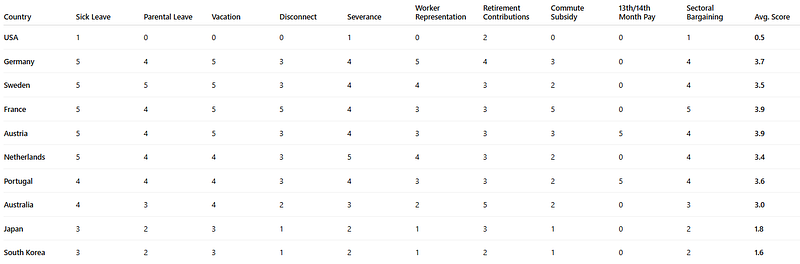
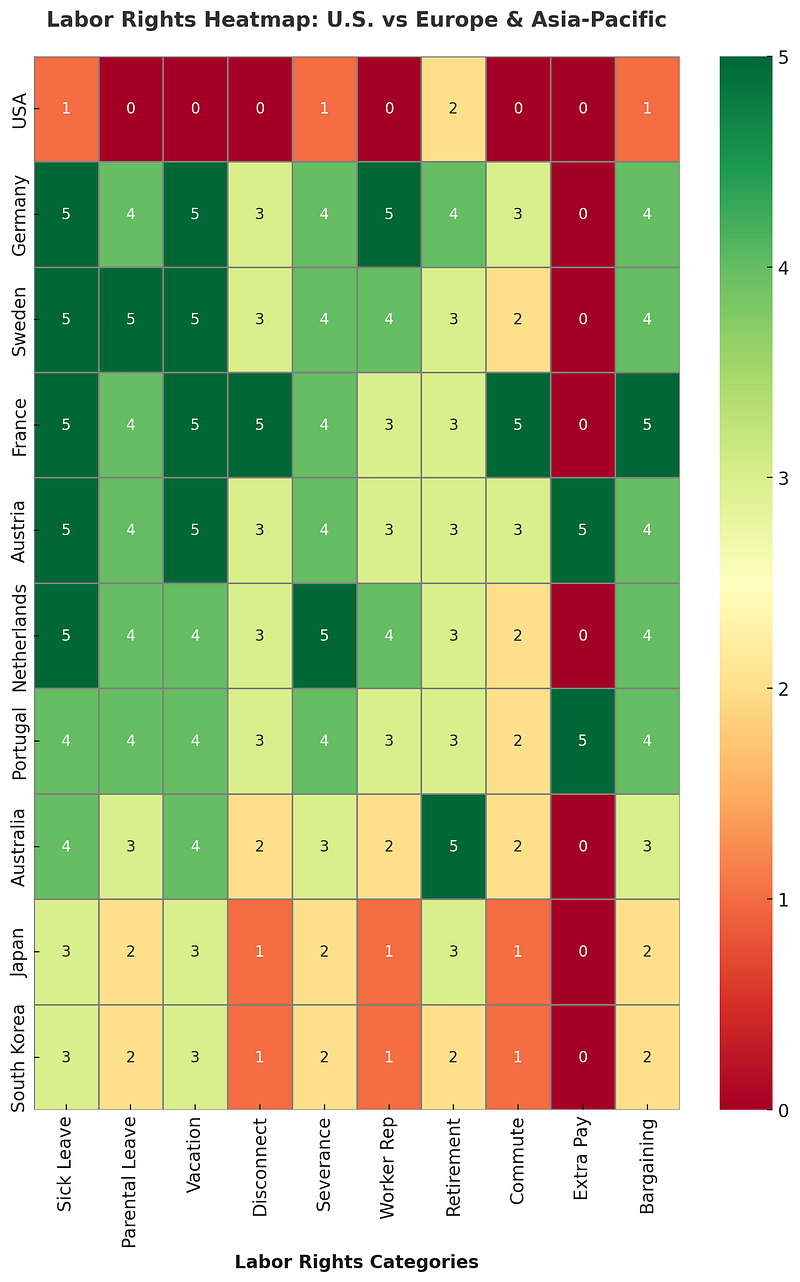
the scored heat-map (0–5) across key labor rights “levers,” comparing U.S. vs. selected countries in Europe and Asia-Pacific.
Here are the chosen levers (based on your earlier article & comparative data):
- Paid Sick Leave
- Paid Parental Leave
- Minimum Vacation Days
- Right to Disconnect (after-hours protections)
- Severance Protections
- Worker Representation (co-determination, councils)
- Mandatory Retirement Contributions
- Commuting Subsidies
- Extra Month Salaries / Bonuses
- Sectoral Bargaining Coverage
Heat-Map Scores (0 = absent, 5 = strongest protections)
Takeaways
- U.S. stands alone with almost no federally mandated worker rights — averaging 0.5 out of 5 across the levers.
- Western Europe (Germany, France, Austria, Sweden, Netherlands) averages 3.5–3.9, with strong worker councils, paid leave, and sectoral bargaining.
- Portugal stands out with 14 months’ pay, lifting its score.
- Australia is mid-tier: strong retirement savings (superannuation), but weaker on paid leave compared to Europe.
- Japan & South Korea score higher than the U.S., but still relatively weak compared to Europe due to cultural norms of overwork and limited collective protections.
This visualization highlights how the policy environment directly shapes resilience to automation.
Nations with strong worker rights have more buffers (income security, retraining potential, health coverage), while the U.S. model leaves individuals exposed.


No Comments
Signup or login to leave a comment